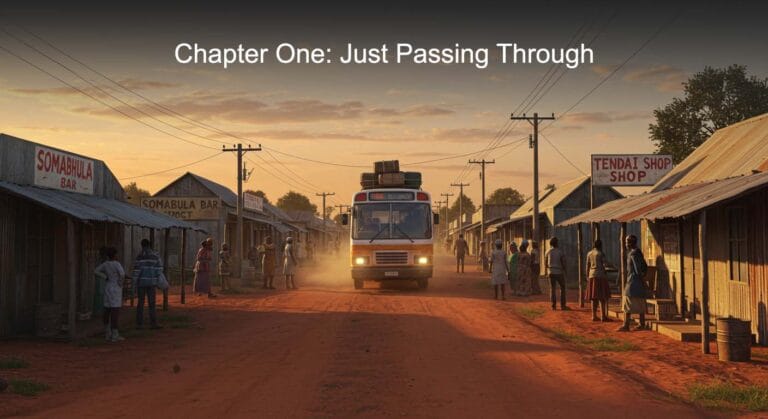
The sun was falling behind the trees. The village was still, the dust slowly settling in the golden light. People gathered close to the stage, men and women standing side by side, the old and the young, every one of them holding the silence like a new blanket.
I stood on the stage, not because I wanted glory, but because it was the right thing. My clothes were torn, my body ached all over, but I looked at Somabhula and I knew this was the time. All the pain and all the battles brought me to this moment.
Biga was near the front, his arm in a sling but his face glowing. Silver, who had always tried to look proud, leaned forward, listening as if he would not forgive himself if he missed a single word. Even Hairline, tall and tired, was there, his spear broken but his spirit unbroken. Children clung to their mothers, and the mothers watched with eyes wide, waiting for the words that would tell them it was safe to laugh again.
I let the silence work for me. I breathed in the warm evening air and let my heart slow down.
“My people of Somabhula,” I began, letting my voice carry. “There are questions in your eyes. I know. There have always been questions. I am the legend you have heard about, the same one who disappeared when the sun rose over Zimbabwe’s freedom. I left, not because I was tired, but because I believed peace would hold. But sometimes, darkness creeps back even when we think it is gone for good.”
People nodded. You could see memories flicker in their eyes. I looked at the edge of the crowd and saw goats wandering back from the hills, stopping now and again to nibble on the thorn bushes. Even the little things had suffered from what had been growing here.
“For many months, the signs have been here. The goats that went missing. The wells that dried up when there should have been water. The cold mornings that would not go away. The children who fell sick without reason. Even the laughter disappeared. You felt it, but you did not know its name. I am here to tell you, you were not cursed. Someone was practicing the old dark ways, drawing the power of Somabhula into themselves, trying to grow strong by making all of you weak.”
A heavy hush fell. I let them sit with it. Then I continued, softer now.
“There are three things a true warrior carries, and they are not all muscles or sharp blades. The first is the smile. You see this smile”—I paused, letting my lips curve—“I wear it not because I have no troubles. I wear it because a smile confuses the enemy and calms the friend. A smile is a shield and sometimes a spear. When you face trouble, do not meet it with a frown. Show your teeth and stand tall. Let the world wonder what gives you courage.”
I heard quiet laughter from the edge of the crowd. Even old men who had never liked jokes nodded.
“The second is the tongue,” I said. “Words are sharper than a broken bottle, if you know how to use them. I have always spoken my mind, even in the middle of a fight. Why? Because the way a person answers tells you more than any punch ever could. It is easy to hide fear in silence, but it is hard to hide it when you are forced to speak. When I talk in battle, I am not just talking to the other person, I am watching, listening, learning how to win before a single fist is thrown.”
Silver grinned. Biga shook his head, as if he should have known all along.
“And the last is calm,” I said. “This is the hardest to keep. When the world shakes, when the dogs bark, when everything in you says to run or to shout, that is the time to be still. Calm hides your weakness. Calm makes your enemy wonder. Calm is where you find the answer that no one else sees.”
I let the words fall, giving them time to settle, then I added, “Let me tell you a story, so you remember this day with more than just wounds.”
“There was a small village on the far side of the river, many years ago. In that place, the river would flood every season, washing away all the crops. The men would run around, shouting and throwing sandbags, but the water always found a way. One old woman, who had lost her house three times, sat and watched the river every night. One day, she began to plant grass and small trees along the banks. She did not shout, she did not chase, she just waited. Season after season, the grass grew. The roots held the banks together. And when the big rains finally came, the water rose and rose, but it did not break through. The people asked her, ‘How did you do it?’ She only smiled and said, ‘The river is strong, but patience and roots are stronger.’ You see, sometimes the answer is not in fighting harder, but in waiting and understanding.”
Now even the children were listening. Some held hands, and a few smiled back at me.
“I tell you all this, not because I am special, but because you are special. Many believe the Nuniya warriors exist only to fight, but that is not true. The Nuniya are the shield and the hand, but Somabhula is the heart. The shout, the AHA, does not belong to only the strong. It is a cry of everyone here, the call of unity. You are all Nuniya when you stand for what is right, when you keep hope, when you protect each other.”
“I left long ago, but I could not stay away when darkness came back. I watched as the laughter faded and the goats disappeared, as the wells dried and the storms would not come. I came back, not because I wanted to fight, but because I could not let evil finish what we had all started together on the day of freedom.”
I looked to the horizon. The sun was almost gone. The air was cool and gentle. All the warriors were on their feet, even the ones who had fallen, standing proud once again.
The warriors moved as one, snapping to the stage, faster and sharper than ever before, filled with a new respect. The villagers, surprised but no longer afraid, shouted back, “AHA!” This time their voices rose up, louder and truer than any war cry, filling the air until even the goats paused to listen.
The women began to sing, old men clapped their hands, and children ran laughing through the dust. There would be a celebration. The wounds would heal. Somabhula, once broken, was coming back to life.
The End.


Chapter thirteen: The Smile, The Calm, and The Tongue
As the dust settled, I stood on the stage and spoke to Somabhula. I told of my smile, my sharp tongue, and my calm—three weapons every warrior should carry. The village began to heal, laughter returning and hope shining.