I lay still on the stage, my face pressed against the boards. I did not move, breathe or even blink. For a long moment, the world around me was only sound. Voices and feet everywhere. People shouted as they climbed higher for a better view. The cries were raw from those who wanted proof that the fight was finally over. Some people cheered, their hands thrown in the air as if they had seen the winning goal in a final. Others broke into tears, hiding their faces, sobbing, unable to watch the thing they had just witnessed. You could hear them all—old women crying, children screaming, men laughing in the chaos.
“He is dead. You saw it. Daves finished him. Finished him for good.”
“Yes, I told you. No one stands after the Nuniya give everything.”
“Did you see how far he flew? Eh, never seen anything like it.”
“He shouldn’t have come here. Strangers must know their place.”
Somewhere in the confusion, the story of the missing goats found its way back to the front of people’s minds. It was as if the pain and joy of the moment pulled up old hurts too. A heavy-set man at the front, arms folded across his chest, said, “Now we can go and look for the goats. Isn’t that what started all this?” But another snapped back, “It’s not about goats anymore baba, it’s about respect. The Nuniya must be feared.”
The Second Master, the one with the white beard, stepped close to the other warriors, shaking his head, his voice hard and cold. “He should not have called the slogan. Only the Nuniya may shout it and only when we answer the Master.” The First Master agreed, his face drawn with lines, his eyes tired, “Yes. The slogan is only meant for Nuniya. He brought this on himself.”
The crowd rolled with feeling—some pressing forward, some backing away, others already calling for a burial. A woman in a green headscarf wiped her face and said, “Let’s carry his body. It’s not right for him to lie in the open like a dead goat. Give him peace.”
But then, through the noise, a boy’s voice cracked the air, wild with shock, “His hand moved!”
People turned on him quickly, scolding and shushing, “How can his hand move? Didn’t you see, Daves used all his power. Don’t bring bad luck, boy. He is dead.”
Others argued, “I saw it. The hand twitched.”
“Impossible, unless—”
The crowd and the boy who spoke went silent, the whole place holding its breath at once as if the world itself was waiting to see what would happen next. Then I pushed my hands against the wood, and I began to stand up, first slow, then steady, my body shaking but my smile never leaving my face, until I stood straight in front of all of them. The whole crowd froze, even the birds overhead seemed to stop in the sky, and Daves was so shocked he turned and looked at the Master, his voice small but clear, “Master, what’s going on?”
That was when someone finally wheezed, voice shaking, “Maybe he is using Dark Arts.”
Now the whispers grew louder, spreading fear like smoke in dry grass. In Somabhula, everyone knew what it meant if someone used Dark Arts. It was never just a story for the warriors. The old people remembered the days when someone tried to use them to get ahead, and the whole village suffered for it. They said when the Dark Arts are used, the rain stops, the maize wilts in the field, goats are born blind, and children fall sick. Sometimes, the river dries up or storms destroy the huts at night. The spirits of the land turn against the people, and nothing is ever the same again. If a fighter uses Dark Arts, he brings darkness to the whole community, and that is why, when there is even a suspicion, the Masters must act fast.
But the O-Form was different. The O-Form was the ultimate technique, taught only to the First Master, the Second Master, and a handful of warriors chosen for their discipline. It was created for one purpose: to destroy anything infected with the Dark Arts, to wipe out the evil before it could root itself in the village. That was why, when the Master turned to the scarred warrior, his voice sounded hard and sure, “Bigger, it is time. You know what to do. Destroy him with the O-Form.”
People started whispering, “Bigger. That’s Nuniya Bigger, the one who tames even the wildest.” Another man said, “He’s the one they always send for Dark Arts, because nothing survives the O-Form, not a snake, not a lion, not a man.”
Bigger stepped forward, his arms bulging, his movements slow at first, his face set like a man about to carry a heavy burden. His hands started to move, circling the air, fingers drawing invisible signs. I could see the power building inside him, the way his breath deepened and the light seemed to bend around his fists. He did not look at the crowd, did not answer their shouts. He was a tamer, a man whose job was to bring down the dangerous before they poisoned the land.
As he began, everyone watched—no one dared look away. The O-Form was the last word, the final answer to the question of darkness. Even the youngest warriors looked afraid, some crossing themselves, as if remembering old stories of the O-Form wiping out monsters and men. I knew that if someone truly used Dark Arts, the O-Form would finish them before their shadow even faded, but I was not afraid, because I was not using anything but myself.
Bigger’s voice was like thunder, “For Somabhula!” and then he struck.
His first punch landed on my chest and I skidded back, pain lighting up my body, blood in my mouth. But I did not fall. He came again, faster now, fists flashing, three times he hit me, three times the stage shook, three times the air was driven out of me, and still I stood, coughing, wiping my mouth, and when he stopped, waiting for me to drop, I looked at him, still standing, still calm, and I said, my voice steady for everyone to hear, “Your three moves were they for practice, or was that your real strength?”
The crowd fell silent, and even Bigger did not answer, staring at me with eyes full of questions that had no answers yet.

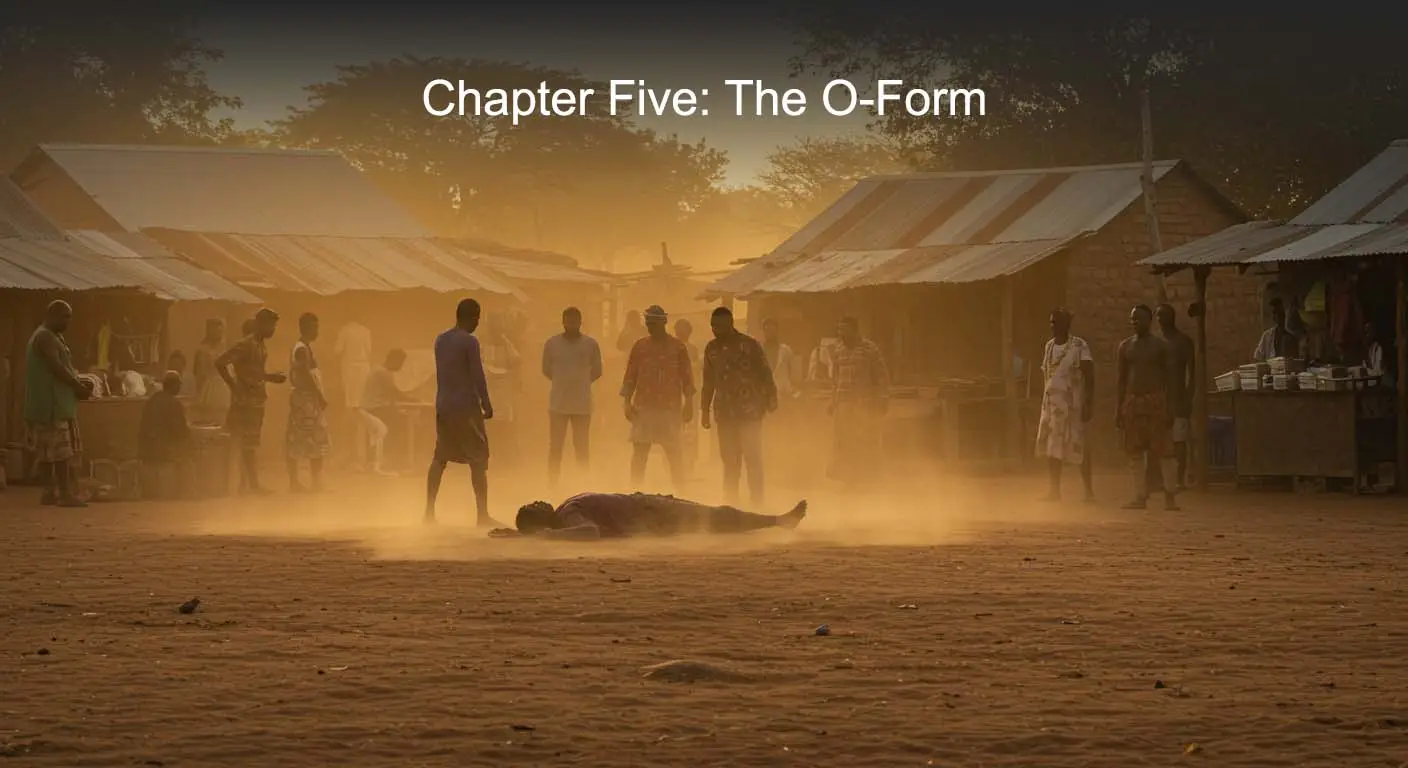
Chapter Five: The O-Form
I lay still as the crowd celebrated my defeat. Some cheered, others argued, and whispers of Dark Arts filled the air. Yet, as they planned to bury me, my hand moved, and shock swept through Somabhula.