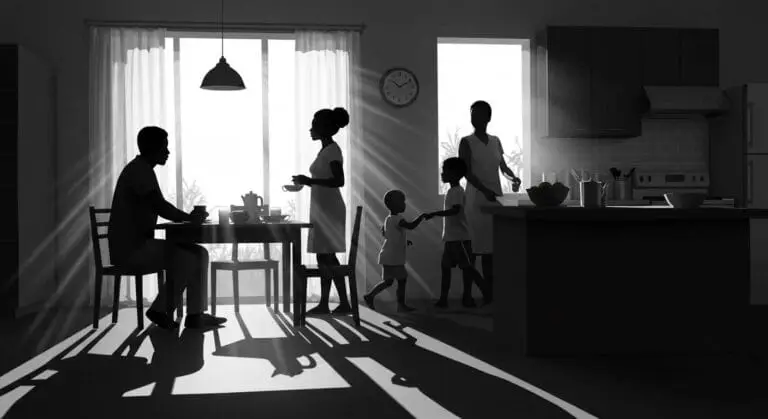


I pulled the gown from the hook and placed it around my shoulders, then tied the belt at my waist. It was a grey gown, a little frayed around the cuffs. It was an original silk gown that always felt slightly damp no matter how long it hung on the hook. For a moment I just stood there and listened to the tap still dripping in the bathroom behind me. I counted each drop as it landed on the tiles.
I walked out of the bathroom, careful not to let the door slam. The corridor was dim and narrow, with patches of sunlight spilling through the small window at the far end. My feet made soft sounds on the cold floor, and I felt the chill climb from my heels all the way to my shoulders. On the right, the wall was lined with faded family photos in mismatched frames. One of them was crooked, but I left it alone. The smell of fried eggs and form drifted through the air.
The corridor opened into the bedroom. Our bedroom. The bed sat pressed against the far wall. The sheets were stretched tight and neat and the pillows were stacked in two careful piles. Jessica had already placed my suit on the bed. She always did this on weekdays. The jacket, grey and pressed, lay across the blanket, with the shirt folded underneath and the tie curled up like a sleeping snake beside it. My socks were set at the foot of the bed, toes pointing forward.
I sat on the edge of the mattress, the gown pulling tight around my knees. For a moment I did nothing. I watched a fly buzz across the room, zigzagging between the window and the mirror above the dresser. The morning light made the dust in the air shimmer and dance.
I reached for my shirt and felt the familiar softness of the cotton, ran my fingers along the line of buttons before sliding each one free. I laid the gown on the bed, smoothed it out so it would not wrinkle. The routine was always the same. Shirt first, then trousers. One sock, then the other, always starting with the left. My shoes, polished the night before, waited by the door. I slipped them on, wiggled my toes, tightened the laces twice for luck.
Before I put on the tie, I paused and looked in the mirror. My reflection stared back, tired eyes, hair still damp at the edges, a crease where the pillow had pressed against my cheek. I ran my fingers along the knot of my tie, remembered how, as a boy, I could never get it quite right. I pulled the fabric through and watched my hands move as if they belonged to someone else. There was a strange line across my forehead, a little deeper than yesterday, and my hair curled where it dried uneven. For a moment, I just looked, searching for something I could not quite name.
Then it happened. There was a smudge on the glass, right where my nose should be, a faint oval left from some hurried morning, and for some reason, that was what did it. That single mark, so small, so ordinary, reminded me of how nothing ever stayed perfectly clean, how every surface collected a bit of the world, no matter how many times you wiped it.
Suddenly my mind was off, drifting. I thought about peace and how it never stayed put, how it was always touched by something else. I found peace a very strange thing.
If you asked different people what peace was, you got different answers. Sometimes they sounded like they were saying the same thing, but if you listened closely, you realised they really were not.
Take Aristotle for example. The man lived more than two thousand years ago, in a place where neighbours were always at war. He said peace was when people obeyed the law and did what was right. He believed peace meant having order, everyone knowing their place, justice being done. Without justice, he said, peace was just waiting to be broken again.
Then there was Shakespeare who lived in England when people were fighting for power, when you could lose your head for the wrong word. He wrote that peace was a gentle and quiet spirit. To him, peace was more than just an empty battlefield. It was the quiet inside you, the ability to forgive, to let go of revenge. Sometimes the real wars, he said, were not outside, but inside a person’s heart.
I remembered at school, we would write, “Peace is the absence of conflict.” That was the answer that got you the marks, a neat phrase that fit in the line on the exam paper. But even as we wrote it, peace felt like something far away, something you could write about but never quite touch.
The Bible said something else. Jesus told his disciples, “I am leaving you with a gift, peace of mind and heart. And the peace I give is a gift the world cannot give.” That was a different kind of peace. It was not about soldiers or speeches. It was something deep, a quietness that stayed even when the world was falling apart. The kind of peace you could not buy or force on anyone, no matter how hard you tried.
But when I looked around, peace still seemed out of reach. Countries went to war, whole armies marching and dying, and leaders said it was all for peace. They stood on stages, waved flags, promised that this time would be different, that after all the fighting, peace would come. But if peace was so precious, why did it need so much blood? If peace really was just the absence of conflict, then why did we not just stop fighting, put down the guns, shut our mouths, and let silence fill the room?
Yet, somehow, we kept fighting for peace. We destroyed what we had, thinking we could build it better. As humans, We argued at home, called it peacemaking, but sometimes all we got was a house full of cold silence. We cut people off and called it protecting our peace. But what was it we were really chasing?
I was no expert in peace. Only read about it or had heard plenty of wise sayings. I had even tried to find it myself, in my own awkward ways.
Could it be that peace showed up in the smallest places, the tiniest moments, not in treaties or grand speeches? Could it be right there, in the smudge on my mirror, in the quiet after I woke up? Maybe. I really did not know.
A sudden alarm buzzed, sharp and urgent, cutting through my thoughts. I blinked, came back to myself, and realised I was running late. The day was already moving, and I had to move with it.